

portfolio
LATEST Projects

SAMPLE - “SELECT” CLINICAL TRIAL SUMMARY
Below is a sample Clinical Trial Summary based on the following:
Study: SELECT — Semaglutide Effects on Cardiovascular Outcomes in People With Overweight or Obesity
ClinicalTrials.gov: NCT03574597
Therapeutic area: cardiometabolic / cardiovascular medicine
Design: Phase 3, randomized, double-blind, placebo-controlled
Population: 17,604 adults age 45+ with overweight or obesity and established cardiovascular disease, but without diabetes.

SAMPLE - starting an ssri (patient education)
Below is a sample evidence-based patient education summary, “Starting an SSRI for Depression or Anxiety: What to Expect, What to Watch For, and When to Call Your Clinician.”

sample - health literacy in informed consent
The following is a focused brief: “Health Literacy in Clinical Trial Informed Consent: What Improves Participant Understanding?”

SAMPLE - OMNICHANNEL PHARMACEUTICAL PROMOTION
Sample campaign for a fictional FDA-approved bispecific antibody for rheumatoid arthritis
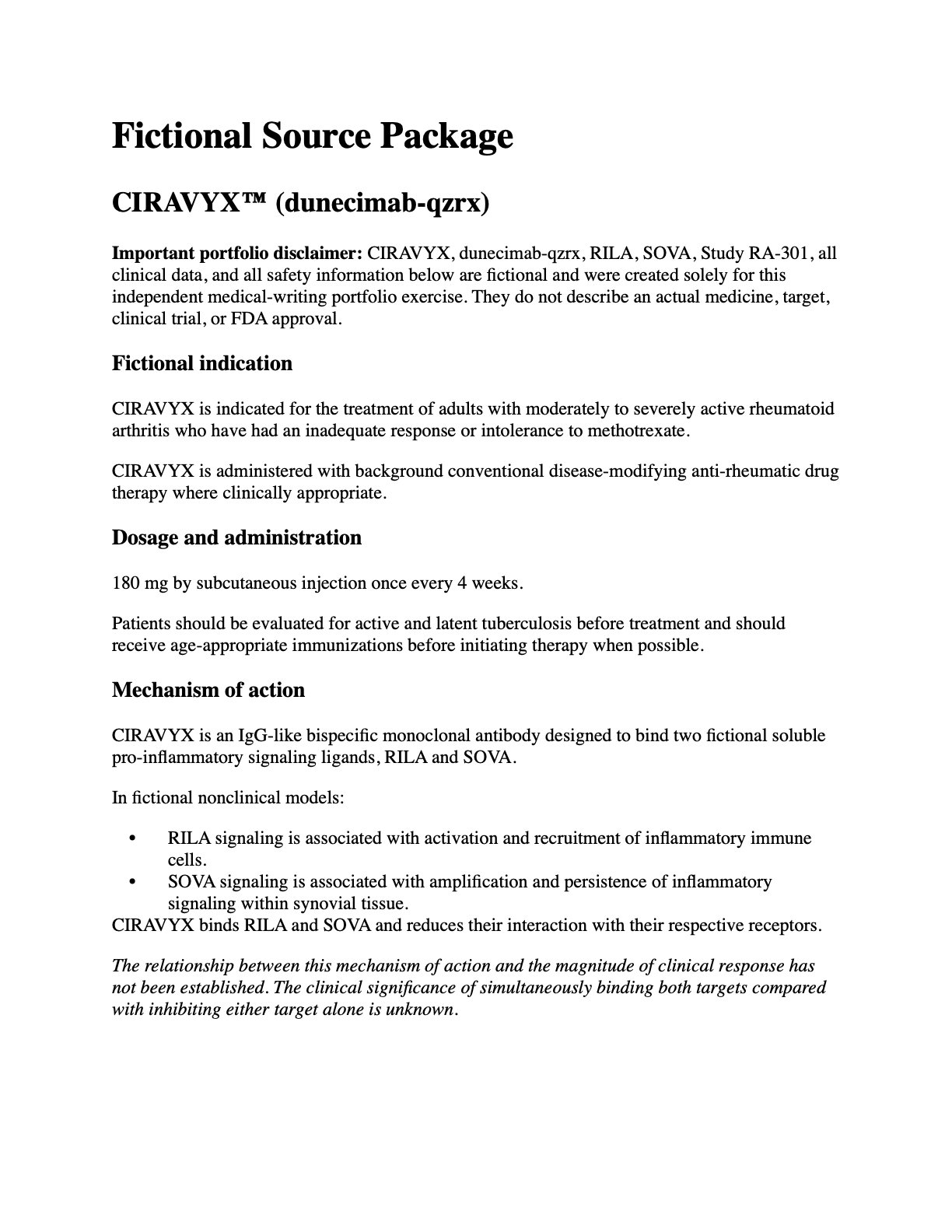
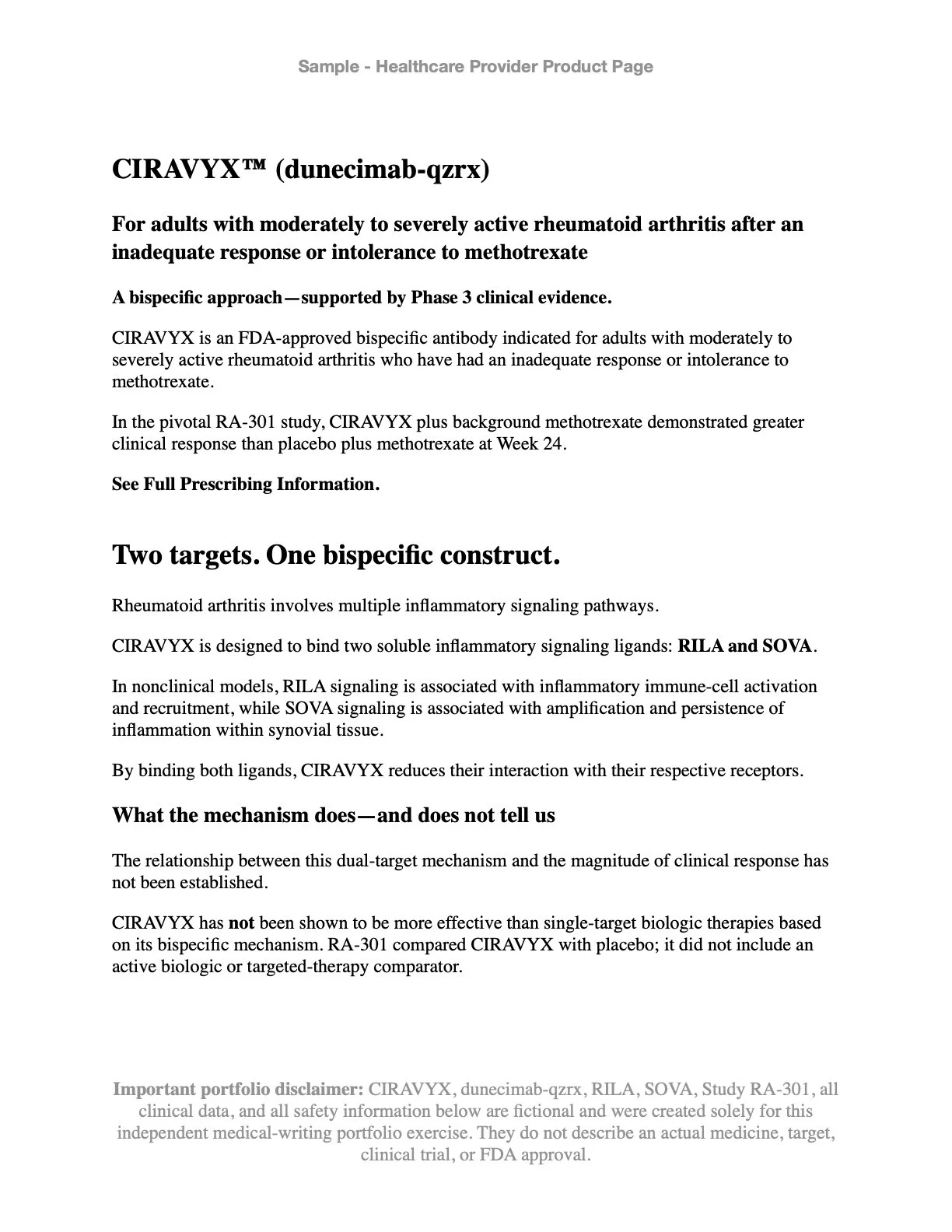
Sample - Fictional Source Data
Sample - Healthcare Provider Page
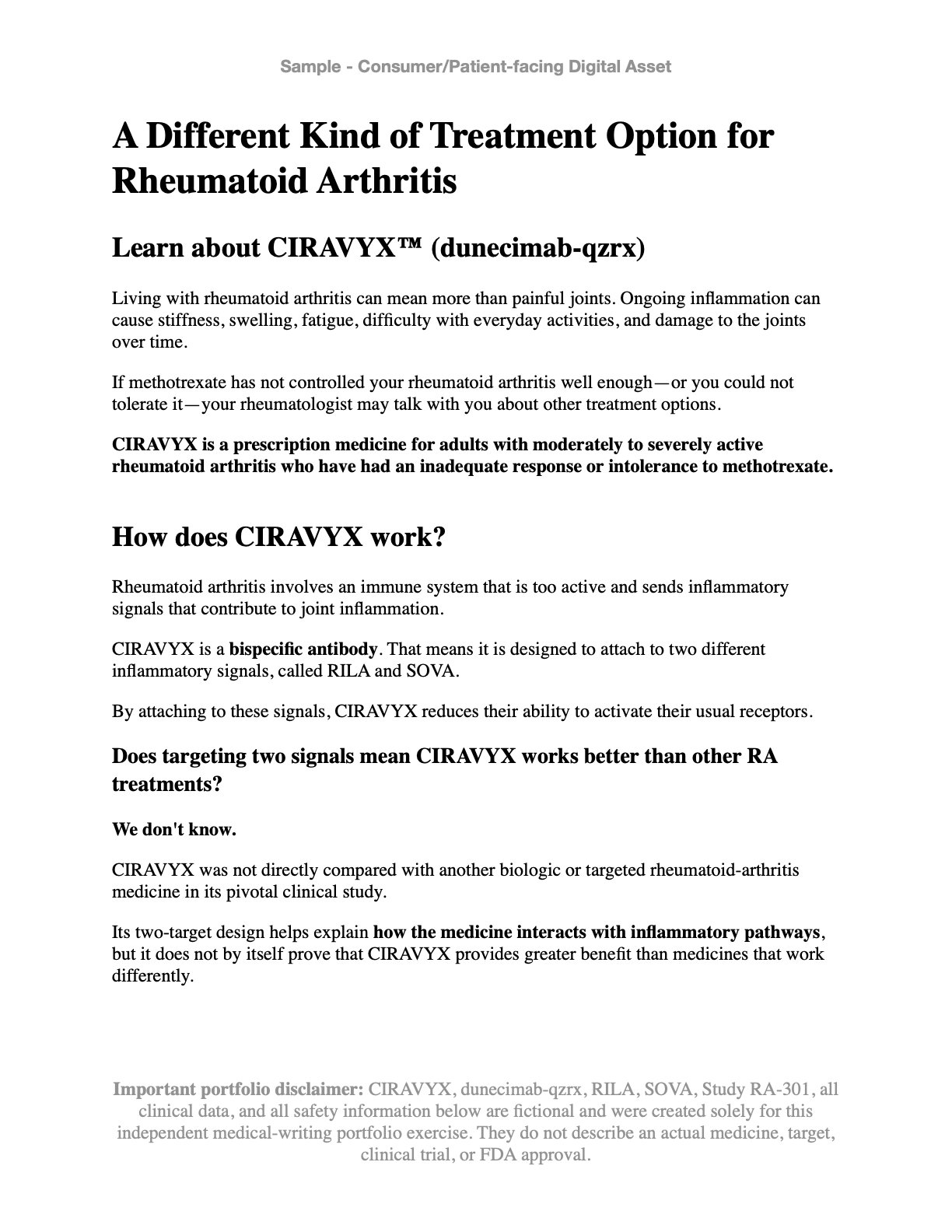
Sample - Consumer/Patient-facing Digital Asset
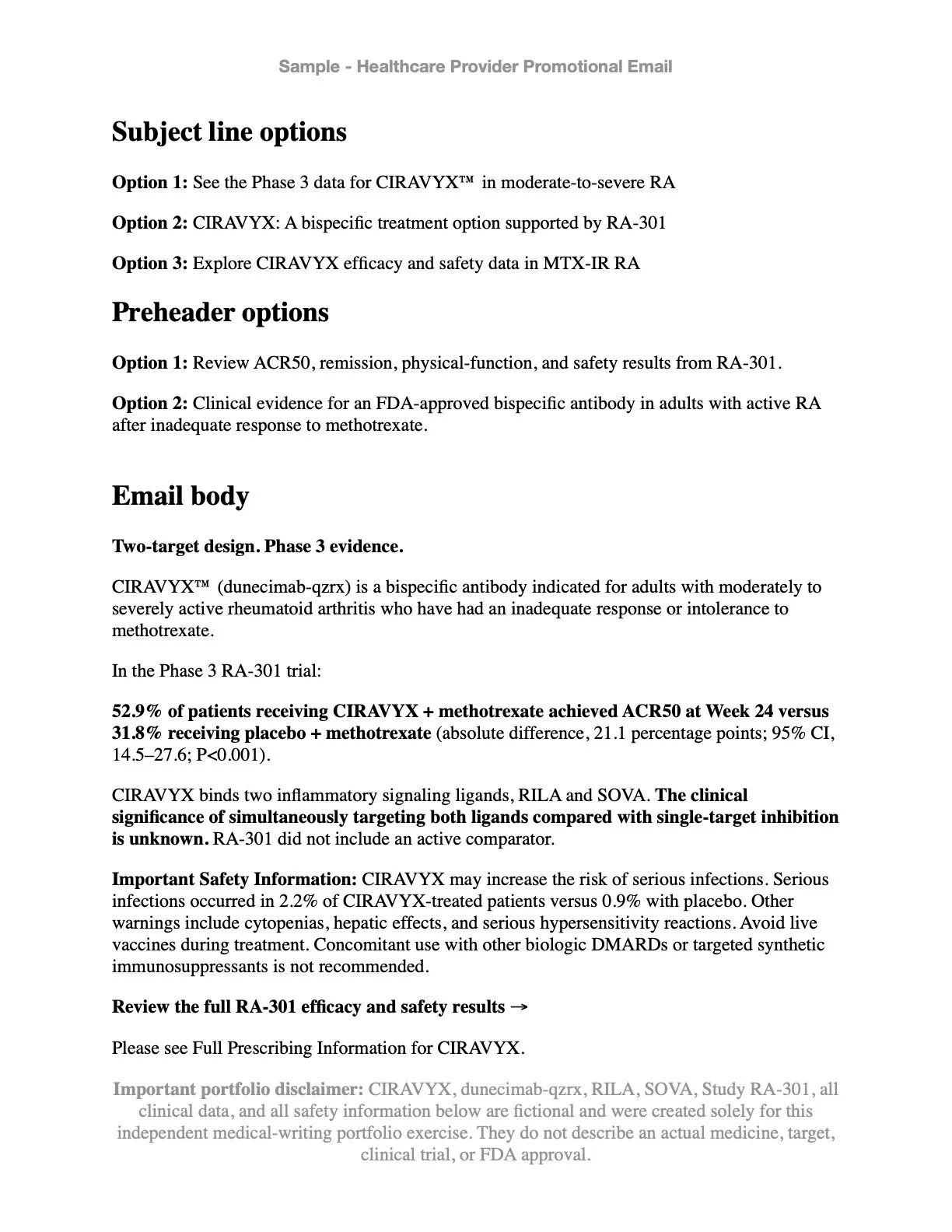
Sample - Healthcare Provider Promotional Email
-
I created this case study as a compact omnichannel pharmaceutical-promotional exercise built around a completely fictional FDA-approved bispecific antibody for rheumatoid arthritis. The campaign includes a branded HCP product webpage for rheumatologists and other specialists, a concise branded HCP promotional email, and a branded patient-facing web asset. I adapted the same controlled clinical and safety information across each channel while changing terminology, level of statistical detail, information hierarchy, and call to action for the intended audience.
I treated the exercise as U.S. prescription-drug promotion operating within an FDA/OPDP and MLR-review environment, with particular attention to truthful and nonmisleading claims, claim substantiation, fair balance, material limitations, benefit-risk presentation, and consistency with the fictional prescribing-information source. CIRAVYX, dunecimab-qzrx, its molecular targets, clinical-development program, trial data, indication, and safety profile are entirely invented for this exercise and do not represent any actual Sanofi or other pharmaceutical product or program. The abbreviated source package is intentionally simpler than a real U.S. Prescribing Information document but is detailed enough to function as the controlled source for the claims made in the campaign.
-
I kept the campaign tightly grounded in the fictional source package. The indication remains limited to adults with moderately to severely active rheumatoid arthritis following inadequate response or intolerance to methotrexate. The efficacy claims use prespecified RA-301 endpoints and do not substitute vague statements such as “better disease control” for the measured outcomes. When I use the 52.9% ACR50 response, I retain the placebo comparison and study context rather than presenting the active-treatment percentage in isolation. I also preserve the most consequential limitation throughout the campaign: RA-301 had no active comparator.
The greatest potential overstatement involved the bispecific mechanism. I intentionally did not claim that simultaneous RILA/SOVA binding provides “broader,” “deeper,” “more complete,” or superior disease control. Those descriptions may sound intuitively reasonable, but none follows from the fictional evidence. I also avoided using the mechanism as the causal explanation for the observed efficacy result. Instead, the copy explains what the molecule is designed to bind and separately explains what happened in the clinical trial. In the consumer asset, I made that distinction particularly explicit because a patient could reasonably interpret “targets two pathways” as “twice as effective” without further context.
I also treated risk information as part of the promotional communication rather than an attachment to it. Serious infection risk appears alongside efficacy in the HCP email, while the webpage provides both an adverse-reaction overview and more prominent Important Safety Information. The patient asset converts serious-infection incidence into an approximate natural frequency but does not use that transformation to minimize the risk. Common adverse effects, laboratory risks, immunization considerations, and limitations around concomitant immunosuppression are retained in language appropriate to each audience.
A real MLR team could reasonably challenge several details. It might want the mechanism copy narrowed further depending on the underlying nonclinical evidence; require additional context around the radiographic endpoint; question how prominently the lack of active comparator should appear; adjust headline language such as “Two-target design”; or require different risk placement based on final visual execution. I would expect that process. My role as the writer would be to show exactly where each claim came from, understand the concern behind a requested change, and revise the language without either compromising source fidelity or unnecessarily stripping the communication of its promotional purpose.
Professional Publishing
-

Caregiving near the end of life: unmet needs and potential solutions
Peer-reviewed qualitative research published in Palliative & Supportive Care examining the unmet needs of informal caregivers of patients with advanced cancer near the end of life.
Conducted within an NCI-designated comprehensive cancer center, the study used seven focus groups and systematic qualitative analysis to identify recurring challenges and potential solutions related to medical care, quality of life, social support, caregiving burden, and communication with healthcare professionals.
Demonstrates: qualitative research · scientific writing · oncology/palliative care · behavioral medicine · patient and caregiver experience · research synthesis. ABSTRACT
-

Effectiveness of Interventions to Increase Follow-Up after abnormal Papanicolaou Smear: a meta-analysis
Focused meta-analysis evaluating controlled interventions designed to improve follow-up after abnormal cervical cancer screening results.
The review identified controlled trials through structured literature searches, classified interventions according to behavioral and cognitive mechanisms, calculated individual and aggregate effect sizes, and examined heterogeneity across intervention approaches. The analysis also addressed methodological limitations including inconsistent definitions of adherence, variation in clinical follow-up, and limited ability to identify which patient subgroups benefited most.
Demonstrates: evidence synthesis · meta-analysis · quantitative analysis · public health · cancer prevention · behavioral medicine · scientific writing. FULL TEXT
-

Social Support and Dyadic Relationship Quality Among Advanced Cancer Patients and their Informal Caregivers
Master’s thesis examining social support, relationship quality, caregiver burden, and quality of life among matched pairs of patients with advanced cancer and their informal caregivers.
The study evaluated 39 patient-caregiver dyads using validated psychosocial and health-related quality-of-life measures and examined both differences within the dyad and associations among support, relationship functioning, caregiver burden, and quality-of-life outcomes.
Demonstrates: primary clinical research · quantitative analysis · behavioral medicine/health psychology · oncology · psychosocial outcomes · patient-caregiver research. FULL TEXT
Book Publications

Published by Magination Press, the children's and young adult imprint of the American Psychological Association, How to Feel Good translates psychological concepts into practical, age-appropriate strategies for adolescents.
The book is grounded in holistic, cognitive behavioral techniques, using relatable metaphors, self-reflection, behavioral exercises, and cognitive and emotional coping strategies to help young readers develop skills related to resilience, self-regulation, problem solving, empathy, patience, and emotional awareness.
Demonstrates: behavioral health communication · adolescent health · consumer health · health literacy · long-form writing · audience adaptation
"With ten-plus years of clinical, research, and teaching experience, Mangan knows how to help teens feel less overwhelmed with daily challenges and changes. Each tip has self-reflection questions, activities, and easy-to-use strategies to put into action when problems arise."
— Portland Book Review